

Your 2026 Guide to Land Tax in Australia
Stamp duty gets all the attention when people talk about the cost of buying property. It’s the big number due on settlement day, so it’s hard to miss.
Land tax is quieter. It doesn’t show up until months later, and then it keeps showing up every year after that.
For investors building a portfolio, this is usually the cost that catches people out. Nobody mentions it during the buying process, so the first notice can feel like it’s come out of nowhere.
What Land Tax Actually Is
Land tax is an annual state government charge on the unimproved value of land you own — not the house or unit sitting on it, just the dirt underneath.
Each state and territory runs its own system, with its own land tax threshold, its own rates, and its own assessment date.
There’s no single national land tax. What applies in NSW has almost nothing in common with what applies in Victoria, and that’s the first thing to get your head around.
Thresholds Vary More Than You’d Expect
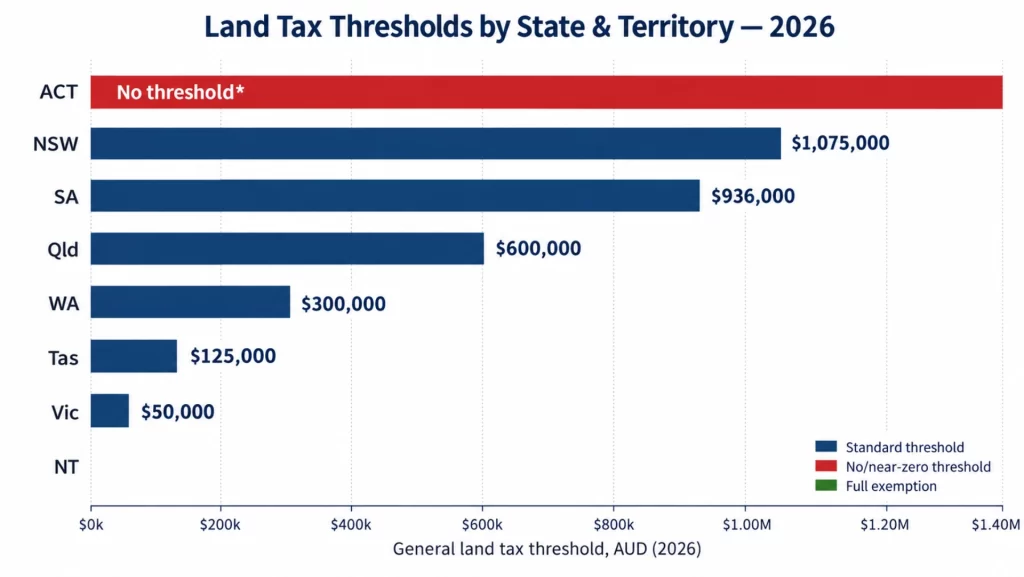
Here’s how the 2026 general threshold stacks up across the country useful context whether you’re buying your first investment property or working out how to build a property portfolio across several states:
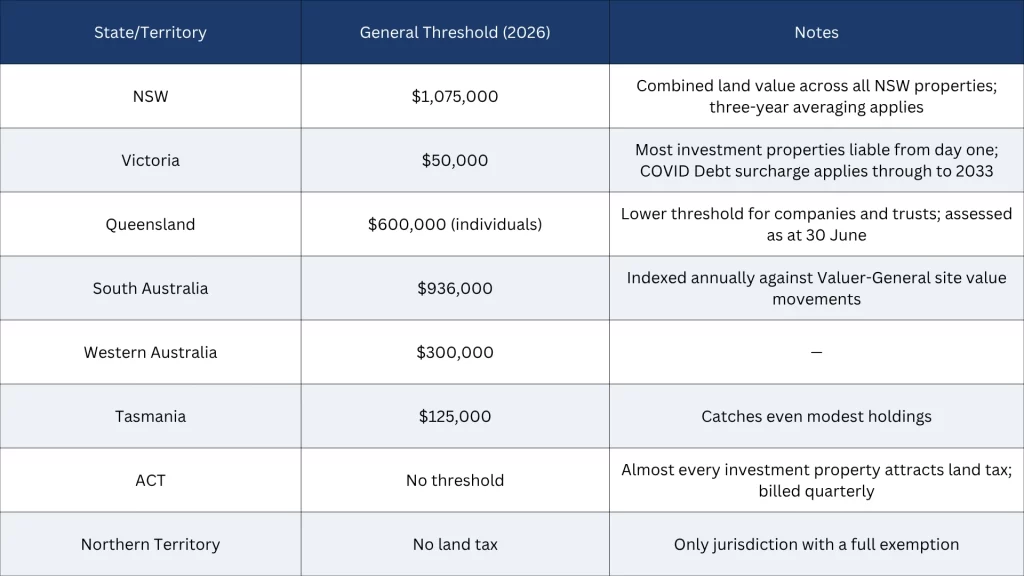
Because each state only counts land within its own borders, an investor spread across NSW, Queensland and SA might comfortably sit under three separate thresholds while the same total holding concentrated in one state, especially Victoria or the ACT, gets hit much harder. This is one reason property investment portfolio structuring across states is worth a conversation with your accountant before you buy, not after.
How It’s Assessed
You don’t lodge a return for land tax. The revenue office assesses you automatically using Valuer-General data and sends a land tax assessment notice once you’re over the threshold.
NSW and Victoria use 31 December as the assessment date; Queensland and South Australia use 30 June. In South Australia, this value is called the ‘site value’, and it’s published each year by the Valuer-General; you can look yours up through SAILIS or RevenueSA’s own portal.
Your principal place of residence exemption applies everywhere, but you only get one. A holiday home, a rental, or vacant land you’re holding all count toward your taxable total.
Land Tax vs Stamp Duty: Two Very Different Costs
It’s easy to lump these together because both are state property taxes, but they behave nothing alike.
Stamp duty (transfer duty) is a one-off cost, paid once at settlement, calculated on the purchase price or market value of the whole property.
Land tax is recurring. It’s billed every year for as long as you own the land, and it’s calculated only on the unimproved land value the improvements you’ve made, like the house itself, don’t factor in.
The practical takeaway: a cheap block in an expensive suburb can carry a bigger ongoing land tax bill than a modest unit on shared land, even if the unit costs more to buy. It pays to check the land value component specifically, not just the headline purchase price, before you commit.
Are House and Land Packages a Good Investment for Land Tax Purposes?
It’s a question that comes up early: are house and land packages a good investment once land tax is factored in? Because the tax is calculated purely on the unimproved value of the block, a newly built house on a modest block can sometimes carry a lighter ongoing bill than an older, established home on a larger one even if the purchase prices are similar. That’s worth weighing alongside the usual considerations, like build quality and rental demand, rather than treating land tax as an afterthought.
A Worked Example: How Land Tax Adds Up
Say a South Australian investor holds three properties in their own name, with a combined site value of $1,200,000. Because South Australia aggregates ownership across all taxable land, the 2026 land tax threshold of $936,000 leaves roughly $264,000 in excess site value, which is taxed at the applicable tiered rate for that band.
The exact dollar figure depends on the current rate schedule for that financial year, so it’s worth running any real numbers through RevenueSA’s land tax calculator rather than estimating. What matters for planning purposes is the shape of it: cross the threshold, and every dollar of site value above it is taxed, compounding a little more with each property added to the portfolio.
Land Tax Aggregation — Why Your Whole Portfolio Counts
Most states don’t assess each property in isolation. They add up the site value of everything you own in that state and apply land tax aggregation rules to the total.
In South Australia, this means properties held in the same ownership structure, the same individual, the same trust, the same company are aggregated and the tax apportioned back across each property based on its share of the combined value.
This is exactly why ownership structure decisions matter so much for multiple property investors. Two properties held in two different structures might sit under two separate thresholds; the same two properties held identically will be added together and assessed as one.
Why It Matters for Portfolio Strategy
Some investors treat land tax as a minor line item next to loan repayments. It isn’t always.
Once you’re past the threshold, the bill compounds every year and grows as your portfolio grows. Property three or four is usually where it starts to bite, particularly in NSW, where the threshold has been frozen and that point arrives sooner than it used to.
The upside: land tax on an income-producing investment property is generally a land tax deduction against rental income, in the same way as interest, rates, and management fees. It softens the hit, but it doesn’t remove it.
What’s Changing in 2026
Land tax rules move more often than people expect, and 2026 has brought a few changes worth tracking:
- Victoria — the COVID Debt land tax surcharge remains in place through to 2033, layered on top of the standard rates for most investment holdings above the $50,000 threshold.
- Victoria — the Building Legislation and Treasury Legislation (Tax Relief) Amendment Act 2026 received Royal Assent in June 2026, introducing land tax and duty relief measures for property owners affected by the January 2026 Victorian bushfires.
- New South Wales — the general threshold has remained frozen at $1,075,000, so three-year land value averaging plays a bigger role in whether a portfolio tips over the line.
- South Australia — thresholds are indexed annually against Valuer-General site value movements, so the figure shifts slightly most years rather than staying fixed.
None of this changes the fundamentals, but it’s a reminder that a threshold or rate you checked twelve months ago may already be out of date.
A Few Ways Investors Manage It
- Spreading purchases across states to stay under multiple threshold limits, rather than concentrating everything in one a core principle of any long term property investment strategy
- Reviewing ownership structure individual, trust, company with an accountant or property strategist Australia investors trust, since thresholds, rates and aggregation rules differ by structure
- Factoring land tax into cash flow projections before buying, not after the first notice arrives
- Checking the land value component specifically, not just the purchase price, since that’s what the tax is based on.
- Running real numbers through the relevant state land tax calculator before settlement, rather than relying on rough estimates
- Asking about payment plan or instalment options where cash flow is tight most revenue offices, including RevenueSA and Revenue NSW, offer these.
The Bottom Line
Land tax won’t make or break a good investment on its own, but it’s a real, recurring cost that deserves a line in your numbers before you buy, not a surprise a year in.
Where you buy, how you structure ownership, and how big your property investment portfolio gets all change how much of it you’ll end up paying. This is exactly the kind of detail the team at InvestPlus works through with clients before they buy, so the first land tax notice is expected rather than a shock. Whether you’re chasing investment opportunities for seasoned investors looking to add property four or five, or you’re still narrowing down your first purchase, a conversation with a property strategist before you sign tends to pay for itself.
FAQs
No. Council rates fund local services like waste collection and roads, and apply regardless of value thresholds. Land tax is a separate state-level charge tied to your land's unimproved value once it crosses a threshold.
Generally no. Your principal place of residence exemption applies in every state and territory. Investment properties, holiday homes and vacant land don't get this exemption.
Sometimes. Different thresholds and rates apply to individuals, trusts and companies, and land tax aggregation rules treat each structure separately. It's worth discussing your specific situation with an accountant before you buy, not after.
Yes. On an income-producing investment property, land tax is generally a land tax deduction against rental income, similar to interest and management fees.
The Northern Territory currently doesn't levy land tax at all, making it the only full exemption among Australia's states and territories.
Stamp duty is a one-off cost paid at settlement on the purchase price. Land tax is billed every year you own the land, calculated only on the unimproved land value, not the buildings on it.
It's automatic. Revenue offices use Valuer-General data to issue a land tax assessment once your holdings cross the threshold — there's no return to lodge, though you can object if you disagree with the valuation.
Each state calculates its land tax threshold independently, based only on the land you hold within its borders. A portfolio spread across several states can sit under multiple thresholds, where the same total value concentrated in one state might not.